Hamstrings Matters, It’s A Matter Of Fact

Hamstrings are located in the back of the upper leg and are seen as the biceps of the legs. The hamstrings can contract (become shorter) and can pull the heels to your own body (think of heels to glutes). The Hamstrings consist of 3 main muscles, the biceps femoris (actually 2 muscles), semitendinosus and semimembranosus. Hamstring injuries are one of the most common injuries in sports. Of the 3 hamstring muscles the biceps femoris is most likely to get injured, followed by semitendinosus muscle and lastly semimembranosus.
How To Stretch The Hamstring?
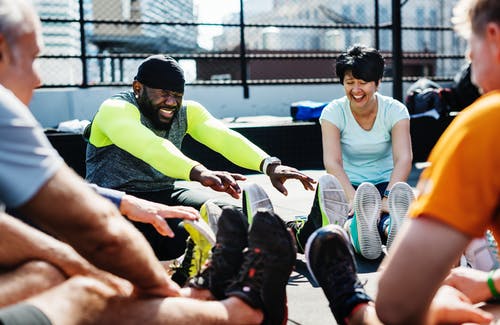
Although stretching the hamstring can bring relief, it is part of a bigger picture. Stretching entails a specific grouping and ordering system that can be found be found by Clicking Here.
How to avoid hamstring injury?
The hamstrings work together with the quadriceps but in opposite ways during many movements. One potential problem with regular exercises is the preference of muscle activation of one muscle group over others. The squat is a good example of a high activation of the quadriceps while a lower activation of the hamstring. Resulting in a lower strength ratio compared to quadriceps (H/Q Ratio). H/Q Ratio is implicated in many injury related problems included knee and hamstring.
Once a hamstring injury occurred, an increased changes chance exist of a hamstring injury occurring again. One of the reasons why the biceps femoris gets injured easily, is its length. Within the same time frame the biceps femoris has a longer distance compared to the other 2 muscles during the eccentric motion. As the biceps femoris is most likely injury, strengthening the biceps fermoris seems logical.
Seems to be the semitendinosus
The force produced by a muscle depends among other things upon motor unit discharge. As we age the motor units discharge in the semitendinosus and the semimembranous decline compared to biceps femoris. This can make the biceps femoris more prone to injure as there is more instability.
How can we train the hamstring ?
The conventional way of training the hamstring has been the deadlift. The deadlift exercise is great for overall strength and trains the back muscle as well as the hamstrings. Furthermore the deadlift targets the hamstrings more than quadriceps, contributing to a healthier H/Q Ratio. The problem with the deadlift is that the research is not clear whether the biceps femoris or semitendinosus is dominant. Furthermore the deadlift doesn’t isolate the hamstrings, training many muscle groups. A training program should consist of targeting the hamstrings in combination with other muscle groups (hamstring) to keep up with the quadriceps and supplemental to focus on the specific hamstrings muscles.
How To Train The Hamstrings
Research shows that the best way to train the semitendinosus and biceps femoris are the following exercises.

Slide leg (without or with band)
- Assume the position on your back, putting your heels on a towel on a smooth surface
- Activate hamstring and gluteus muslces
- Pull your heels towards your glutes
- Slowly extend your legs back to starting position

Fitball flexion
- Assume position on your stomach
- Put a swissball on your glutes, letting a trainer holding the swissball
- Pull your heel towards the swiss ball and press your heel into the swiss ball, using your hamstring.
- Slowly assume starting position
 stretch for health